Gerrit's reflections
Why do vegetable fats originate in the tropics?
The main components of oils and fats are so-called triglycerides. These molecules have the same structure in all oils and fats, namely a glycerol backbone with three fatty acids attached (see Figure 1). This applies to both vegetable and animal oils and fats. For example, the oil in a fish near the South Pole has the same structure as the oil from a coconut. How is it that plants and animals always use triglycerides as building blocks, despite living in very different conditions? How does nature adapt the properties of triglycerides, and what does this mean for their use in our products?
The properties of triglycerides are determined by the composition of the fatty acids. The three fatty acids can differ in length and degree of unsaturation (number of double bonds). Saturated fatty acids have a high melting point, while unsaturated fatty acids remain liquid at 0 °C. Hundreds of combinations of fatty acids are possible within triglycerides, and oils and fats are mixtures of different triglycerides. Nature makes effective use of this: by selecting the right combination of fatty acids and triglycerides, the melting behaviour and consistency of oils and fats are adapted to their function in plants and animals. Oil is liquid at room temperature (around 20 °C), whereas fat is solid.
In warm-blooded animals (including humans), fatty acids are relatively saturated, resulting in fat with a relatively high melting point. Due to the high body temperature, this fat remains more or less fluid, allowing it to be transported through the body. Organs are often protected by a layer of firmer fat with an even higher melting point. Fish living in cold water would not be able to move with such fat; in their case, fatty acids are highly unsaturated, resulting in a low melting point.
A similar distinction is found in vegetable oils. In the warm tropics, fatty acids in oils are relatively saturated. Despite their relatively high melting point (30 °C or more), these oils remain liquid due to the high ambient temperature. Saturated fatty acids are far less prone to oxidation than unsaturated fatty acids, making these oils more stable at higher temperatures. Outside the tropics, however, these oils would become solid due to lower ambient temperatures, making them unavailable as an energy source for germinating crops. Oil crops outside the tropics therefore contain unsaturated oils with melting points well below 20 °C.
Humans use oils and fats for purposes other than those for which nature developed them (from here on, only vegetable oils are considered). For certain applications, such as dressings and mayonnaise, we use oils that are liquid at room temperature. Liquid oils are also commonly used for frying. For other applications, such as the solid phase of margarine, chocolate and bakery fats, we require fats that are solid at room temperature. Crops that provide these solid fats cannot grow in cooler climates and therefore come from the tropics. The most well-known tropical oils are palm oil, palm kernel oil, coconut oil and cocoa butter. Due to its high yield, palm oil is the most important of these. Oilseeds that produce liquid oils do not grow in the tropics because of the oxidation sensitivity of unsaturated fatty acids. As a result, people in tropical regions use tropical oils for food preparation.
During a visit to Ghana, I observed the sale of oil palm fruits at a local market (see Figure 2). These are boiled in water at home. After some time, the lighter palm oil rises to the surface and can then be used for cooking.
In summary:
- Crops that provide vegetable fats contain a high proportion of saturated fatty acids and grow only in the tropics.
- Crops that provide vegetable oils contain a high proportion of unsaturated fatty acids and do not grow in the tropics.
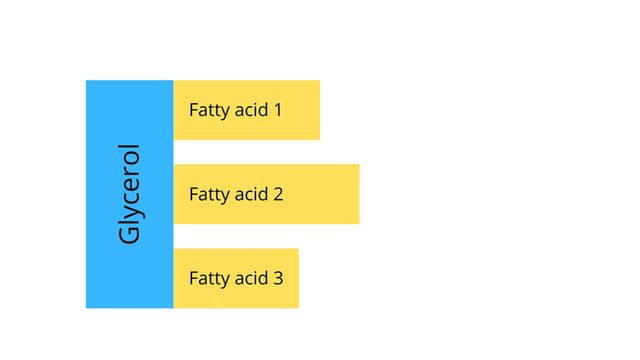
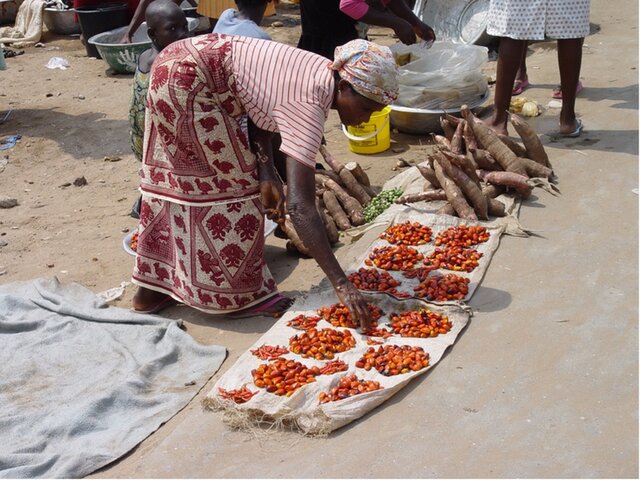
Figure 1 The structure of Glycerol
Figure 2 The selling of palmfruits at the market in Ghana
Gerrit van Duijn, with roots in Delft and a PhD in engineering sciences, spent decades working in the oils and fats sector, including roles at Unilever and MaasRefinery. Now retired, Gerrit shares his reflections and experiences as a columnist in our magazine. Over the next editions, readers will discover a new story each time in the series Gerrit’s Reflections.